Showing posts with label Computer Games. Show all posts

Friday, December 1, 2000

Uni Essays (1997-2000): "How is ESCAPISM in computer games different to traditional forms of storytelling?"

I found the old essays I wrote for my Arts Degree at Melbourne University (1997 - 2000), and decided to upload some for historical interest and general self-reflective purposes! 


"All forms of narrative allow people to momentarily escape the restrictions and limitations of their own lives by entering the world of fiction.  How does escapism in computer games work differently from traditional forms of story telling?"

Subject: Computer Games - Interactive Spectatorship

by Murray Lorden (2000)


In reality, you quickly get used to the fact that there are physical and social rules and boundaries, which have a very real influence over the limitations of your everyday life.  It is through the frames of entertainment forms that we experience a world outside the borders of our own lives, and are freed from the restrictions and strains of everyday life.  When you turn on a computer game, a whole new world of possibilities suddenly opens before you, allowing you to virtually transcend your own physical and social boundaries, and perform in one of these virtual dramas.  


All forms of narrative allow for this escape because you can become mentally and emotionally involved in the performance of a drama that occurs within a frame that excludes real life.  Everything outside the frame can be momentarily dismissed.  And these bordered worlds allow for narratives with closure, resolution and meaning; things which defy stability in real life, hence the allure of the frame.  


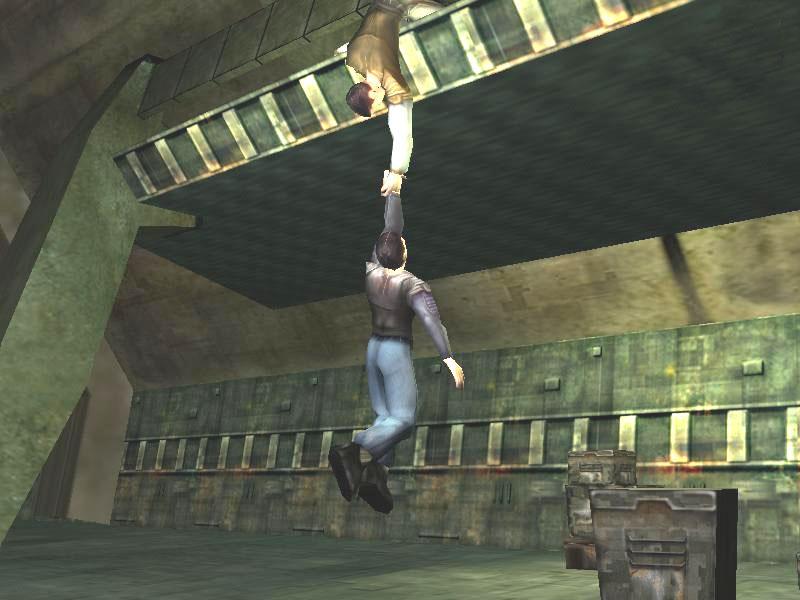
People yearn for something that will allow them to dismiss their life from their mind; to focus their attention on a sustained narrative that is alternate to their own lives.  Even oral traditions of storytelling have this attribute of inclusion and exclusion, even if there is no physical frame.  One such computer game narrative that I became heavily involved in was Half Life by Valve Software.  Half Life is a first person shooter (FPS) which takes its themes from a wide variety of genres, such as survival horror, action and war films.


Computer games allow for a special type of escapism that focuses on the user as both spectator and performer simultaneously.  Generic conventions have become so highly ritualised and formulaic, with an audience that is so familiar with them, that the conventions become the currency of pleasure in themselves.  The narrative conventions now make up the content of an interactive medium whereby the audience must trigger the next event themselves to forward the narrative, and their heroism is measured by their competency at performing within the conventions of the game world.  


These illusionistic realities appear at once related to real life, while at the same time being outside the sphere of reality.  In this process of the exclusion of your own worries and concerns, you are still associating things from your own life to the drama in the frame, but the frame allows you to sideline those real-life concerns by focusing in on the narrative event at hand.  For example, while playing Half Life, I would get deeply engrossed in the challenges of the game, thus “tuning out” of my real life concerns.


Such entertainment also offers a safety zone, in which the game’s entities and inhabitants can be depended on to make sense and remain consistent.  In the case of computer games, a whole environment and its inhabitants can be depended on to behave in a set way.  This allows the user to comprehend them completely, “master” them, and perfect their own performance in that environment.  Our real world lacks defined rules and boundaries.  In these games, you can attain a level of control and autonomy that is not possible in real life.  In Half Life, you become more and more familiar with the behaviour and movements of the enemy units, and with your own arsenal of weaponry, and after long enough you become an veritable master at controlling your avatar and manipulating the environment.


Games have not legitimised themselves institutionally in the way that other forms of artistic production have.  Perhaps this is because, instead of becoming immersed in the meaning of a book or a film, in computer games, the process of engagement is more often an engagement with the challenges set by the game, such as the challenges of mastering the controls, or of “unlocking” the narrative through puzzle solving.  Computer games have certainly never been very interested in searching for “higher meaning” in things, nor have they tried to philosophise on the human condition.  The kind of escape experienced when playing a computer game is certainly very different from other types, such as absorbing yourself in cinema or literature, which often have more abstract, philosophical and internal issues as their interests.


Games are often experienced in a more segmented form where the events of the plot are likely to be played out through missions, quests or recurring scenarios.  These scenarios do not usually carry any authorial comment, as the hand of the author is more likely to be concentrating on the gameplay itself than working on the deeper meaning of the narrative events.  The emphasis is placed on the player themselves to perform the narrative in an environment laden with “moments of narrative” that are set up by the game developers.  And so, in games, we are not just allowing ourselves to be absorbed in the events occurring in the frame as we do in a film or a book, but we must actively take control of an element that exists as our proxy within the game world and show that we can play along.


This makes the process of escape into a computer game quite different from other narrative-based media.  While a film or a book is generally experienced just for the length of time it takes from start to finish, games allow for the mind to be indefinitely distracted, so long as the simulation of the game world remains appealing.  It is much like a card game in that so long as the “rules of the game” keep you engaged, you can repeat the scenario over and over and over.  Because “games” are rule-based, the outcome is different each time.  Each experience is unique and you can engage with the text indefinitely.  A good example of this is the act of playing Half Life, where the rules that govern the environment are so enthralling that I have begun the game several different times, just to “live” the same narrative events over again in a new way.  Furthermore, by being able to play Half Life in multiplayer mode against other players online, you can engage yourself in the recurring scenarios indefinitely.


Speaking of how you focus your attention into a defined frame and exclude what is outside it, Britton says, “Entertainment…defines itself in opposition to labour, or, more generally, to the large category, ‘the rest of life’, as inhabitants of which we work for others, do not, in the vast majority of cases, enjoy our labour, and are subject to tensions and pressures that the world of entertainment excludes.”


Curiously enough, the experience of playing a computer game could so often be seen as labour.  Computer games are full of problems to overcome, puzzles to solve, objective to complete and tasks to manage.  In Half Life, your main goal is to navigate your way out of the Black Mesa Research Facility and get to the surface.  You are constantly having to evade enemies, restock your supplies, maintain your equipment, and solve puzzles.  In adventure and mystery games, it can get to the point of wandering around, hopelessly stuck and lost, or getting frustrated with attempt after attempt at a puzzle you can’t solve.  But this frustration itself can still satisfy the desire to escape into the frame.  At least in computer games, you know there is an answer, it just needs to be found.  Once you solve a difficult problem, the feeling of reward is all the greater.  And unlike real life, there is always just the possibility to give up completely without negative consequences.


Britton also says, “artefacts that tell us we are being entertained (the requisite feature of the kind of product I have in mind) also tell us that they are promoting ‘escape’, and this is the most significant thing about them.  They tell us that we are ‘off duty’, and that nothing is required of us but to sit back, relax and enjoy.”  Although games require more engagement than to sit back and relax, they certainly do allow you to allocate your time as ‘off duty’.  As the player becomes involved in the game, they in fact make a contract about being on duty inside the game environment.  The player’s sense of responsibility and connection to the events in the game encourage a deep sense of escape from real life as you focus in on the challenge of the virtual realm.


Games allow you to process a specific set of rules against which you can test yourself, setting goals and achieving them, getting satisfaction from how well you understand the conventions you are negotiating with.  Therefore it is a special form of escapism, perfectly suited to making the user feel rewarded and satisfyingly occupied.  It is a way to feel as though you have a mastery over the world as a whole by mastering a particular set of rules.  This is quite different from traditional forms of entertainment, or perhaps it would be more accurate to say that it is a synthesis of many different forms of entertainment, combining narrative-based entertainment with rule-based games.


In the case of reading novels, the reader’s perception of the environment and events are always different from the author’s due to the nature of the form.  You are not explicitly shown the environment or events, but rather, they are illustrated through the abstract medium of words.  The main means of immersion is through eagerly reading on to see how the narrative unfolds, and how resolution is reached.  The performance of these events is dictated by the author, and involves the reader by engaging their expectations and desires, and by the reader’s act of mentally processing and considering the implication of the text.  Similarly, in mainstream films, you are immersed in the performance of the events of the narrative, as explicitly recorded by the process of production.  All of the dead time is taken out, and the events of the story unfold quickly and neatly, with nothing left to do except receive the product. Again, the spectator mentally processes the text, but cannot influence the performance in any way.


Hypertextual fiction still involves almost purely authorial domination.  The reader can only put together pieces of predetermined, authored work.  The same could be said about computer games, seeing that all of the game content must be pre-authored by the developers, but in the case of hypertexts, the user does not have the opportunity to perform, only to choose.  In computer games the player is given a realtime simulation of an environment rich in narrative possibilities in which to perform quite freely.


In the case of computer games, the interactivity of the text is the centre-point of the medium, and the element which really sets it apart from other forms of story-based entertainment.  It is a form in which the exact performance can sometimes surprise even the developers of the game.  The medium is less expressive than traditional story based forms due to the lack of directorial control of the performance of each moment, yet can still be very atmospheric and dramatic.  And it is especially engaging in that it requires the player to exercise their agency for the narrative to progress.  Once you learn how to effectively exercise your agency, you can achieve a strong sense of control over your environment, domination over its inhabitants and mastery over your own behaviour and actions.   Rather than just follow the plot, you must navigate the performance space, filling the appropriate role in the game based on the conventions the game draws upon.


In games, you become a force within the narrative, usually as a character involved in the narrative, usually the protagonist, or maybe even a god or overseer.  What sort of role you will play in the game is usually very clear from the beginning.  Generic conventions are used to give you clear guidelines as to how you are expected to behave in order to be successful in the game world.  For the narrative of the game to reveal itself, you must negotiate a progression through the text by understanding your position within the narrative.  The type of role you will play is usually determined by clearly defining the style of gameplay in terms of existing genres, such as action films, adventure stories, or mysteries.  Your performance within the game world is then measured in terms of how well you live up to the conventions of the genre.  For example, when playing Quake, you must show proficiency as an action hero, much like Rambo.  In Half Life, you must be proficient as a “thinking” action hero, like Bond.  In a game like Powerslide or TOCA Touring Cars, you must have the skills of an accomplished racer, like those sportsmen you see at racing events or on television.


You can also play (or replay) a game in a different way each time, or with different objectives.  Depending on your desires, the contents of the game can change in proportions, where you may decide to avoid fighting and vie for stealth in an action title.  Half Life allows you to befriend some non-player characters (NPC’s) and team up with them, cooperating in your battle against the invading aliens.  Alternatively, you can just kill them on sight, or use them for bait to shift the attention of the enemy away from yourself.  Many contemporary games are now putting an emphasis on such a diversity in possibilities of gameplay styles in the one game.  For example, the advertising slogan for Deus Ex was, “Your goal is to save the world.  How you do it is up to you!”  Still, you know it will not be by organising charity events.  Rather, it will be through your choice of the available generic conventions, such as being a cyber-punk hacker, an action man, or a stealth master, or a fluid combination of all types.  This ability to fluidly move between different roles illustrates how liberally games play off the array of generic conventions.  There are plenty of optional “side-missions” which add to this feeling of player agency, making a real difference to what story ends up being told.  This is different from traditional storytelling, in that the performance is set in stone and exactly the same every time it is told.


Speaking of today’s audience having such a familiarity with entertainment conventions, Britton describes his experience of going to the opening of a film called Hell Night.  “It became obvious at a very early stage that every spectator knew exactly what the film was going to do at every point… The film’s total predictability did not create boredom or disappointment.  On the contrary, the predictability was clearly the main source of pleasure, and the only occasion for disappointment would have been a modulation of the formula, not the repetition of it.”  Just such an ability to pre-guess the events of the narrative are the joys of computer games, where it is often your ability to perform the formula that is the test of your abilities and the measure of your success in the game world.  It is because genres have built such strong conventions that spectators are literate enough to want to perform within the array of generic conventions themselves.  


This aspect of computer games is played out well in Groundhog Day, where Bill Murray’s character keeps repeating the same tasks over and over, trying to improve his performance through practice and repetition.  He is just a sarcastic, bitter news reporter, but wants to turn the story into a romantic narrative by altering his behaviour over recurring versions of the one day to fit the role of the romantic male.  


Computer games cannot really afford to go a long way into breaking their own narrative ground due to their interactive natures, as the player would have no way to guess at how to exercise their agency.  Games must refer to mythic conventions and other narrative works so that the player has guidelines to understand their own possibilities of agency.


Britton says that, “[entertainment forms] are primarily engaged in referring to themselves and other movies, and related media products, and in flattering the spectator with his or her familiarity with the forms and keeping of a hermetic entertainment ‘world.’ ”  This is certainly true of computer games, where the possibilities inherent in the text itself are made up of what could be seen as a database of mythic possibilities.  The game developers lay out an interactive trail of narrative possibilities, made up of their game entities, each of these built from mythic principles and signifiers.


Soon we will see the first games which use Dynamic Mission Generators, which are basically databases of narrative nodes that employ AI formulas to keep track of and administer the state of the narrative world.  Such systems will be used in up and coming Massively Multiplayer Online Role Playing Games (MMORPG’s) such as Freelancer and BigWorld.  These are the closest things yet to Janet Murray’s concept of the multiform plot.  Such a system allows for an ongoing storyline that emerges based on player agency, generating reactions to players’ actions based on the rules of cause and effect.  It is a different kind of storytelling, where the composition of the narrative is not pre-written in a script, but exists as a complex table of possibilities with formulae being used to administer and distribute events throughout the simulated theatre of possibilities.  


It will be very interesting to see what the future of narrative theory holds, considering that the new MMORPG’s allow for unpredictable and freeform combinations of the developers’ range of narrative possibilities.  The stories are many, crossing over one another, but are experienced linearly by each individual participating in the game.  What will be made of these multi-narrative worlds, based on complex formulae of narrative “nodes”?  Where will we look to find the meaning of the game?


Computer games allow for a brand of escapism that is unlike previous narrative media.  Traditional narrative forms do not allow a dynamic mingling between the author and the spectator, whereas computer games, with their use of formulae and rule-based storytelling, emphasise the spectator’s role in helping to perform the narrative.


BIBLIOGRAPHY

  • Adams, E., “Three Problems for Interactive Storytellers”, Gamasutra, 27/12/99.
  • BigWorld - Interview with the developers: http://bigworldvault.ign.com/features/interviews/bigworld01.shtml
  • Bolter, J. & Grusin, R., “The Remediated Self”, Remediation: Understanding New Media, MIT Press, Cambridge MA, 1999.
  • Bolter, J. & Grusin, R., “The Virtual Self”, Remediation: Understanding New Media, MIT Press, Cambridge MA, 1999.
  • Britton, A., “Blissing Out: The Politics of Reaganite Entertainment”, Movie, Winter, 1986.
  • Crang, M., “Public Space, Urban Space and Electronic Space: Would the Real City Please Stand Up?” Urban Studies, February, vol. 37, no. 2, 2000.
  • Featherstone, M., “The Flaneur, the City and Virtual Public Life”, Urban Studies, May, vol. 35, no. 5-6, 1998.
  • Hansen, M., “Early Cinema, Late Cinema: Transformations of the Public Sphere”, Viewing Positions: Ways of Seeing Film, ed. Linda Williams, Rutgers UP, New Brunswick, 1994.
  • Jenkins, H., “Opening Remarks”, Computer and Video Games Coming of Age, transcript of Conference at MIT, 10-11 February 2000.  (http://web.mit.edu/cms/games/transcripts.html)
  • Laurel, B., “The Nature of the Beast”, Computers as Theatre, Addison-Wesley Publications, Reading, 1991.
  • Mitchell, W., “Replacing Place”, The Digital Dialectic: New Essays on New Media, ed. Peter Lunenfeld, MIT Press, Cambridge MA, 1999.
  • Murray, J., “The Cyberbard and the Multiform Plot”, Hamlet on the Holodeck: The Future of Narrative in Cyberspace, MIT Press, Cambridge MA, 1997.
  • Ndalianis, A., “Evil Will Walk Once More – Phantasmagoria: The Stalker Film as Interactive Movie?”, On a Silver Platter: CD-ROMS and the Promises of a New Technology, ed. Greg Smith, New York, New York University Press, 1999.
  • Poster, M., “Cyberdemocracy: Internet and the Public Sphere”, Internet Culture, ed. David Porter, Routledge, New York, 1997.
  • Rutsky, R. & Wyatt, J., “Serious Pleasures: Cinematic Pleasure and the Notion of Fun”, Cinema Journal, vol. 30, no. 1, Fall, 1990.

FILMOGRAPHY
  • Bladerunner James Cameron        1982
  • eXistenZ David Cronenburg        1999
  • The Fifth Element          Luc Besson        1997
  • Groundhog Day Harold Ramis                         1993
  • Matrix, The Andy & Larry  Wachowski      1999
  • Wayne’s World Penelope Spheeris                1992

GAMOGRAPHY
  • Blood 2 Monolith          1998
  • Carnivores 2 Wizardworks 1999
  • Commandos Pyro          1997
  • Deus Ex Ion Storm 2000
  • EverQuest Verant 1999
  • Flight Unlimited Looking Glass Studios 1996
  • Half Life Valve 1997
  • Kingpin Xatrix 1998
  • Powerslide Ratbag 1997
  • Quake Id Software 1995
  • Quake 2 Id Software 1997
  • Quake 3 Id Software 1999
  • Sims, The Maxis 1999
  • Soldier of Fortune          Rogue 1999
  • System Shock 2 Looking Glass Studios 1999
  • Thief 2 Looking Glass Studios 1999
  • TOCA 2 Codemasters 1997
  • Tomb Raider 2          Core                                        1997
  • Ultima Online          Origin 1998


Uni Essays (1997-2000): "Do virtual public spaces pose a threat to material public spaces?"

I found the old essays I wrote for my Arts Degree at Melbourne University (1997 - 2000), and decided to upload some for historical interest and general self-reflective purposes! 


“Do virtual public spaces pose a threat to material public spaces?”

Subject: Computer Games - Interactive Spectatorship

by Murray Lorden  (2000)


With the rise of the internet, we now find ourselves in a world where a large percentage of the developed world is connected together in a network of personal computers in the home.  This allows for easy communication in the form of emails, instantly delivered messages, and also allows people to enter shared virtual three-dimensional spaces.  As the software and hardware involved improves, and as the bandwidth between users increases, these virtual public spaces will offer richer experiences and perhaps even replace the need for some of our current material public spaces.  I don’t think that this should be considered a threat, as even when a material space becomes redundant, that material space would then be repurposed, and used in a different way.


While talking about virtual public spaces, I will concentrate on multi-user networked three-dimensional spaces, as experienced in online worlds, particularly games.  These virtual spaces are the most advanced, and most used, so they are a good case to study.  Overall, these virtual public spaces have offered the chance for users to enter virtual environments in which they can play and socialise, but have not replaced the need for material public space.  People meet for very specific activities, such as playing a particular game, or discussing a particular topic.  Users who enter these areas usually do so rather than reading a book, or watching television; activities which generally occur in private space.  It is an alternative leisure activity.  


Like the telephone made “more” private space, so these online worlds make “more” public space.  They offer a virtual alternative to material communication.  However, each niche area that virtual public spaces can be used for, such as chatting or gaming, could pose a threat to their material counterparts in that they may be used instead, thus eclipsing the material alternative.  But this is not quite how we have experienced virtuality so far.  The invention of the telephone has not stopped us from talking face to face, just as emailing people has not stopped us from using the phone.  Largely, these new technologies just allow for more communication.  Virtual spaces are just extensions of the material world, and rely on this world for their meaning.


Virtual public spaces are obviously not equal to material public spaces.  Users know that they are being remediated when in these spaces.  They know that there are many layers between themselves and other users when they meet in cyberspace.  So do these virtual spaces allow for a sense of community?  We have already seen that they do.  Friendships are made online all the time; in newsgroups, and on messageboards, and in game worlds.  I personally know a friend who has now moved to America to live with a woman he met on the internet.  They are now engaged.  Such stories are becoming more and more commonplace.  The sense of community that develops in these virtual spaces is born from people sharing their similarities and commonalities.  Just like in the material world, people with similar interests and aspirations come into contact with one another and develop relationships.


In what ways are these communities different from what we are used to in the material world?  Well, there are special conditions of entry into these spaces, such as needing to have the appropriate hardware, software and know-how, but this only reflects equivalent conditions that people usually have to fulfil to enter a social group, such as having knowledge of the particular area of interest that holds the people together, and having the correct manner to fit into the social niche.  This access-barrier will become a lower and lower hurdle in the future, as cheap consoles will allow for such connection to these spaces with minimal expense and know-how.  And so as these virtual public spaces become more and more commonplace, the purpose of material public spaces may well change in focus, or perhaps they will simply remain as the place where people really come together to “meet in the flesh”.  Besides, how do you meet for a coffee online?


Playing your favourite game online is much like going to your local disco or sports field, where you will meet strangers and familiar faces alike.  Depending on whether you go with friends, or alone will change the way you experience the space.  You can enter these material spaces alone, cooperating and competing with strangers, or you can enter with a group of friends or your own regular team.  You can likewise play online games on your own, with the intention of interacting with strangers, or just stick close to some friends or your regular “clan”.  However, there is one striking difference.  In the material world, it is very likely that you will recognise those people who you have met before, but in virtual spaces, where people’s appearance can easily change completely, it is not always easy (or even possible) to familiarise yourself with other people.  This is an important distinction, and I think it goes a long way to ensure that the material world will always be the most important realm.  It is the place in which you must really prove your worth and reliability to others in the community.  It is your physical body, even when your own dealings with others are virtual, that unifies all that you do.


Playing games has always helped prepare children for their adult life.  It gives them experience in communicating with their piers, organising events, and negotiating rules.  Now, some may argue that playing games online removes the “good old fashioned, face to face qualities” of traditional game playing.  But it seems appropriate that today, games are sometimes played online, seeing that the online realm is becoming more and more important in everyday life; in business, in communications, in paying your bills, in shopping, in so many areas of adult life.  And so it is fitting that this should be part of today’s youth growing up.  And today’s games are becoming quite complex social realms.


Ultima Online, the first graphical Massively Multiplayer Online Role Playing Game (MMORPG) currently has over 180,000 subscribers worldwide.  And these people all socially interact.  Some people have criticised such virtual spaces as being incapable of expressing a sense of community due to the rampant player-killing and lack of direction among players.  Almost all of these games include fighting as a fairly central feature.  But this aspect of conflict is not really a phenomenon that is limited to game worlds.  It stems from the celebration of competitiveness and domination in our capitalist, material society.  Conflict is an important part of social interaction, and cannot be avoided.  It is the other half of cooperation, and you cannot have one without the other.  In fact, each works to define the other.  Conflict stems from opposed objectives, which is an integral part of life, and the process of negotiating such conflict is an important experience to practice.


In these online game spaces, there are different currencies involved in the player interaction.  Sometimes, in games such as Quake 3, these currencies are limited to health and ammo.  The reason a player plays the game is because they want to compete with those currencies.  And the performance of that competition is where the tension and glory comes from.  Just as a person embraces the types of interaction that take place in a material space they enter, thus the rules of engagement are defined by the rules of the space.


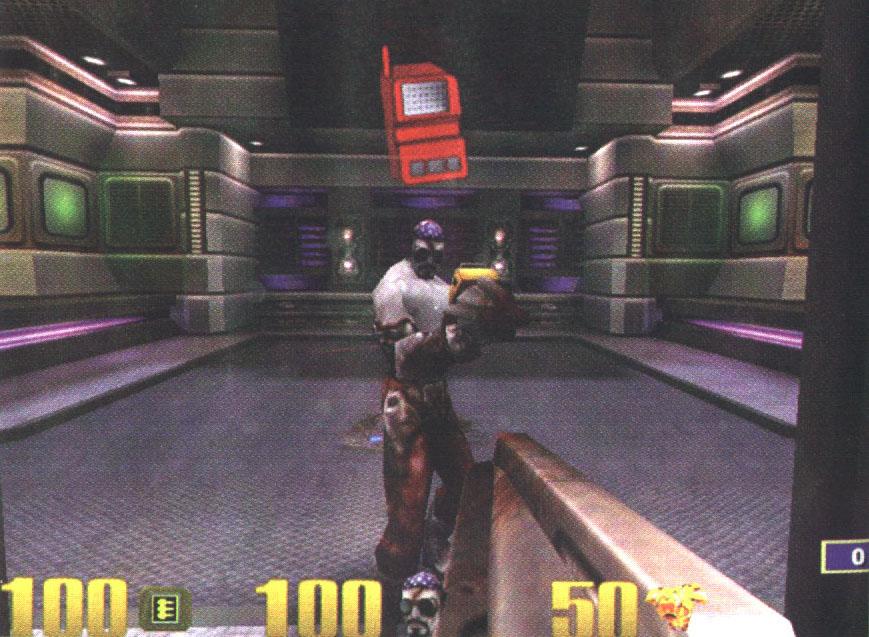
Quake 3 – Narrowband society: just guns, frags and taunts.


Quake 3 is an online only game, where the only way to play is to compete against other players.  The player with the most “frags” (kills) when the set time limit is up wins.  You can’t even put your gun away, even if you wanted to (which would be suicide).  It is basically more like a sporting event, similar to when sports teams meet once a weekend to compete.  When a player connects, sometimes they will find a few familiar people online, and build up familiarity.  Usually players from the same geographical area will find each other due to their connection speed (or “ping”) being similar.  And hence, a community can grow, much like a sporting community.  Games like Quake 3 are based on what I call “the bully paradigm”.  There is no emphasis on constructive or cooperative social interaction; domination is the only goal.  In this sense it is much like many games played in the schoolyard, including the competition and conflict involved in the social hierarchy.  


In this sense, games like Quake 3 could be considered a threat to material public spaces such as sports fields, which could become redundant if all “sport” is played online.  Yet I don’t think this will happen.  Physically playing sport is a very different activity than playing computer games, and there will always be a desire for material spaces where people can exercise and meet face to face.  Physical mastery of your own body and sense of coordination will always be an important part of life.


At the opposite end of the spectrum are online virtual worlds like ActiveWorlds.  These environments portray themselves as not really being games, basically because there are no set objectives.  There are however, many set rules and guidelines, and a select group of possible actions and forms of interaction.  There is strictly no violence possible.  But as a result they often seem purposeless; limited by their own refusal to offer specific currencies with which to compete and interact with.


This mirrors the gameplay of many of the MMORPG’s that have sprung up in the last year or two.  To allow for the masses of players to all have something to do, there must be very little in the way of a defining narrative.  Each character is their own author, each trying to carve their own niche in the community.  Ernest Adams, a veteran game designer, explains that, “I won’t go so far as to say that interactivity and storytelling are mutually exclusive, but I do believe that they exist in an inverse relationship to one another.  The more you have of one, the less you’re going to have of the other.”  This maxim has certainly been a factor in the making of these games, where guidelines have been kept very vague to allow for maximum freedom.


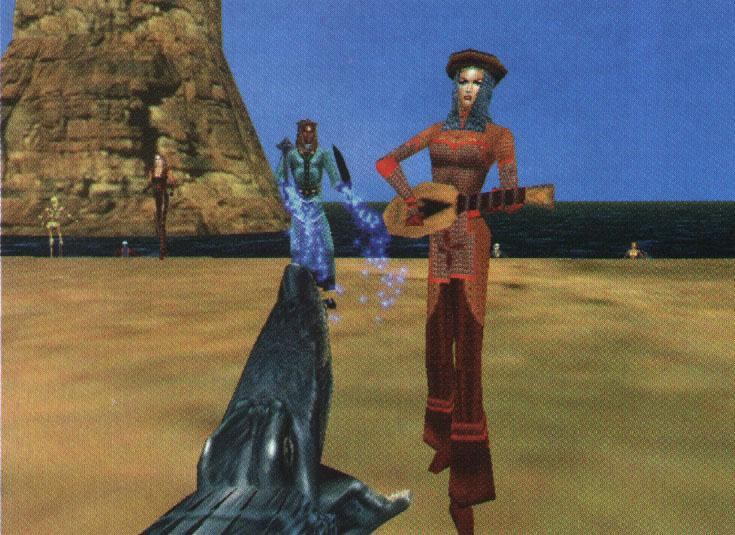
The closest relative to ActiveWorlds in terms of Online Games is probably EverQuest.  Like ActiveWorlds, the purpose of existing there is not set in stone (to put it gently), which can sometimes leave a player feeling a bit lost.  


EverQuest – Taking MMORPG’s into 3D.


Like ActiveWorlds, or many other online virtual realities, you can choose to inhabit the body of all manner of creatures.  This brings up the issues of avatars.  In games such as this, you are asked the question, “Who do you want to be?”, and are then given the choice of a large range of cyber personas.  This presents the idea of the utopian avatar, where you have the chance to choose and become a sort of ideal alter ego.


This utopian ideal of the potential of avatars entertains the idea that you can have the body you wish you had and do whatever you want to do!  But are these possibilities really how we experience these virtual identities?  I would say that such possibilities are very real, but within game environments only.  It is not as though we experience such freedom with our virtual identities in our business dealings, for example.  This is another important distinction that needs to be made.  These fantastical virtual spaces are aimed more directly at game players, particularly children, while adults are more likely to use virtual spaces for practical reasons, such as email, or in the future, meetings and product visualisation presentations.  In such cases, virtual identity is most likely to as closely as possible represent your material identity.  The truth is, adults don’t have that much time to play games, and when they do, there is a clear distinction between such game playing and the material world that we all return to when the game is switched off.  


But for those who do have time to play in these persistent worlds, you can take on quests and continue to develop and improve your character indefinitely.  The aim of the game is self-betterment, much the same as real life.  The current aim of MMORPG’s is to provide a detailed, three-dimensional online environment with a lot of freedom.  The emphasis is on social interaction and character development.  The most important thing to the player is their own avatar, and the interactivity between avatars is slowly increasing with each game.  Perhaps these games will soon provide something of a reality for those with utopian views about virtual existence.

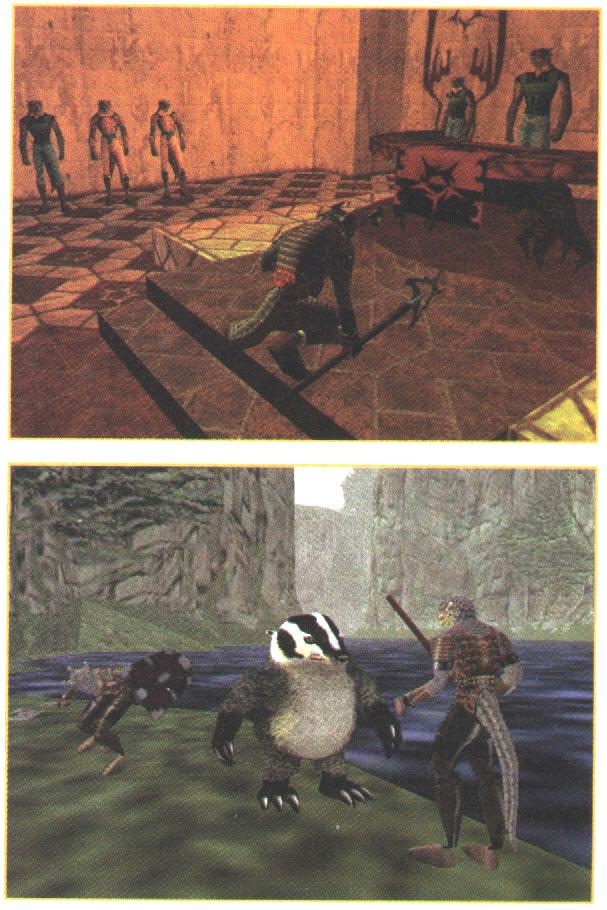
EverQuest Expansion Pack: Ruins Of Kunark – These online worlds can be added to indefinitely, with new “episodes” in the form of new lands to explore and new avatars to choose from.


But then there is the dystopian vision of what avatars could be, such as is seen in The Matrix.  Here we see the avatar as a potential prison cell that you are locked inside, unaware that it is not your real body.  In this film, a whole species is hooked up into a big VR run by the machines that the humans once built.  The film explores the fears of complete loss of control of your own life; a fear of not knowing what is real.  And even after finding out the truth about your delusions, some may wish to be seduced back into ignorance.  It raises the question, “What if virtual reality ends up being better than life, period?”  Yet ultimately, although the film shows VR as a potentially dangerous space, it also presents it as a fantastical space where you can do the impossible, if your mind is strong enough.


eXistenZ entertains similar fears, suggesting that game spaces can be both dangerous and exciting.  It again raises fears over losing control of reality, and confusing illusion for reality.  These two films are ultimately concerned with what will happen when you can’t tell the difference between virtual spaces and material spaces.  


Well, that certainly seems to be where games are trying to go.  But how far will they get?  Will they really try to simulate reality, or will they always maintain a distinct fantasy element to separate themselves from the real world?  I will look at a few of the latest games being developed in order to consider these possibilities.


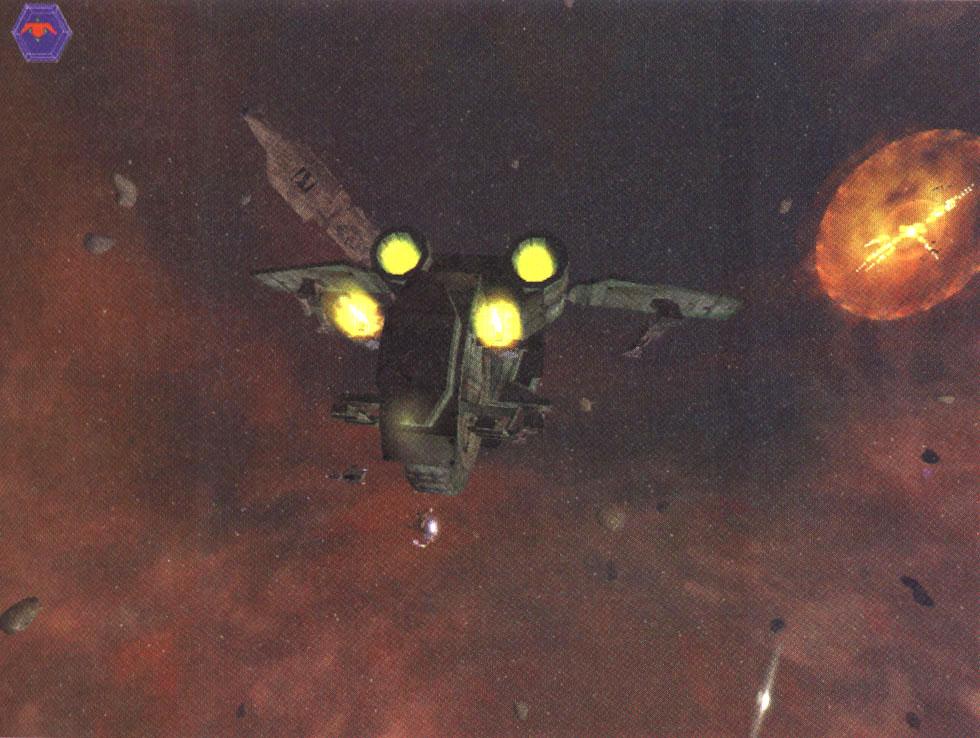
Freelancer is a MMORPG where you are a freelance pilot in a large expanse of the galaxy, in a time of exploration and mass expansionism.  The purpose of the game is survival.  This really echoes the reality of our material world, yet it is experienced in an alternative, much more action packed and dramatic world.


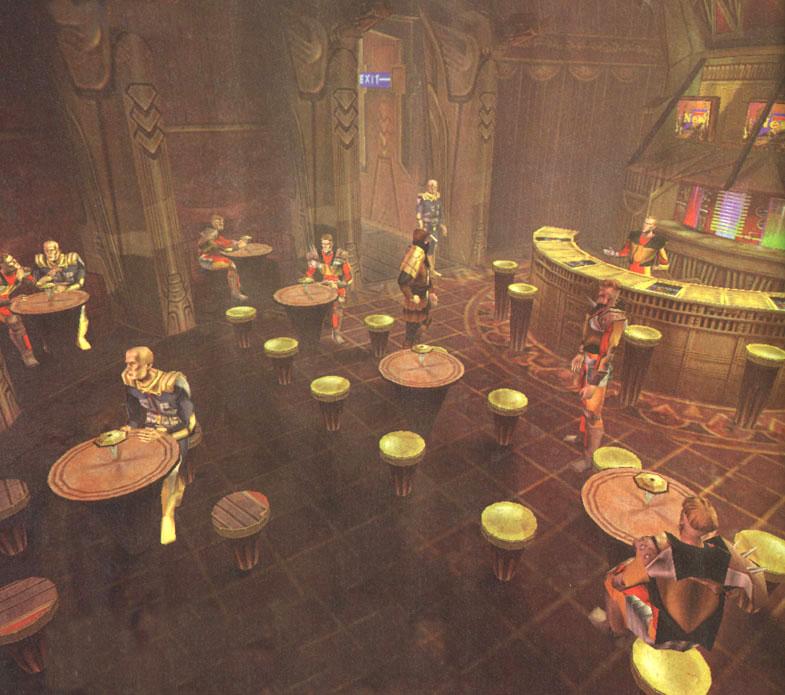
Freelancer – A bar scene where you can pick up work and hear the latest news and gossip.


The game really depends on what the player wants to do.  You could play it safe and play as a ship merchant, shipping goods and supplies to various points in the galaxy for a tidy profit, living from bar to bar, keeping your eyes and ears open for more work.  Or you could join the military and take part in escort roles, simple patrol routes or attack sorties.  Or you could play as a bounty hunter, or an outright pirate.  Alternatively, you can freely swap between roles as it suits you.


Basically, whatever you choose to do, your profits get pumped back into your ship, improving and upgrading it, mainly for the purpose of ensuring your survival in the future.  


The mission generator is complex, offering missions based on the events throughout the galaxy.  For example, if pirates have raided a grain supply on a certain planet, relevant missions will be offered such as taking a cargo shipment of grain to the planet, or tracking down and capturing the pirates responsible.  The events of the game world thus depend on the actions of the players involved, and also on the AI involved in the game, where Non-Player Characters (NPC’s) will give you missions based on the events occurring elsewhere in the galaxy.  Just like the material world, the galaxy does not stop moving just because you are asleep.


Freelancer – You are just a spec in the galaxy.


Within this galaxy, there is plenty of potential for social interaction such as alliances, cooperation and diplomacy, as well as their opposites such as competitions and duals.  Freelancer appears to offer pretty much more of the same as other MMORPG’s, but with subtle innovations and more complexity.  It could certainly suck up a lot of someone’s time, perhaps keeping players away from their usual material haunts.  But again, it is probably largely going to be students who have enough time to play the game, and the time could well have previously only been spent watching TV, or enjoying other private leisure activities.


Another unreleased MMORPG is an Australian title called BigWorld: Citizen Zero.  It is set in a distant galaxy, in a city named Neo-Eden. Once a penal colony, Neo-Eden experienced a revolution some fifty years ago and is now a free and technically advanced society.  Despite the state of freedom, prisoners still arrive there through some means of teleportation, with their memories erased.  This process cannot be stopped.  As a player, it is now time for you to blend in with the rest of the world and live a successful existence.  The concept for the game was based partly on Australia’s history as a penal colony, which is an interesting crossover between virtuality and reality.


There is an emphasis on cooperative gameplay and social interaction.  There are going to be strict limits on violence and combat, not due to censorship, but intended to increase the potential of more dynamic gameplay.  The lead writer for the game, Camille Scaysbrook, states that she is determined to take the emphasis away from the paradigm where combat equals achievement.


BigWorld – An emphasis on cooperation and social interaction.


The Lead Designer of the game, Paul McInnes, is a cultural anthropologist.  I think this illustrates two points.  It shows that computer games and virtual public spaces are being taken much more seriously than they were in the past, thus attracting people from areas of academia into positions of development, not just criticism.  And it also points to the potential of the up and coming MMORPG’s, in that as the technology allows for more dynamic interaction, that is just what we will get.  These virtual public spaces are rising to their potential.  Social scientists becoming involved in the design and implementation of these environments is both heartening for concerned critics and encouraging to an audience who yearn for more from games than just bloodshed.  It gives these public spaces a much greater potential as a rich virtual space.  


BigWorld uses an innovative mission system to create individually customised missions for the characters, and an original system of active NPC organisations to create a living frontier society to explore and master.


The aim is that players will be able to leave their mark on the game world.  As the producer, Steve Wang says, “The game helps you become “someone” in the online community.  Character actions and reputations are taken seriously by the world at large.  This helps players create a sense of belonging to the world, or better still, of the world belonging to the players.  For example, a leader of a gang of the Cybrid Mafia becomes one of the “street scum” to a member of The Bureau, a dread enemy to all members of the Grey Collective, a potential assassin for hire for the less scrupulous Overarchs, a possible target for a bounty-hunter and a potentially interesting public figure to citizens at large.”  Ultimately the aim is to allow the player to make a difference and be remembered.  But the point is, who will remember you?  Who is the audience?  The audience is made up of the other players.  And each player is simultaneously actor and spectator.  Just like in reality…  


The ideal public space seems to be one where people can get together, and feel good while sharing a space, and even carry that positive feeling away with them when they leave.  And it seems as though this can be achieved in virtual public spaces as well as material ones.  And certainly, virtual spaces will become more popular in the future, but I don’t think that this will threaten material public spaces, but will just force them to alter their emphasis.  The bigger question here seems to be, “Does virtuality pose a threat to reality?”  And the answer must be, no, because virtuality is just another aspect of reality.  Ultimately, virtual public spaces are just more space, as much a part of our reality as the town square, or the coffee shop, each with their own specific purpose.  But it would seem that these virtual spaces are best suited for fun and games.


BIBLIOGRAPHY

  • Adams, E., “Three Problems for Interactive Storytellers”, Gamasutra, 27/12/99.
  • BigWorld - Interview with the developers: http://bigworldvault.ign.com/features/interviews/bigworld01.shtml
  • Bolter, J. & Grusin, R., “The Remediated Self”, Remediation: Understanding New Media, MIT Press, Cambridge MA, 1999.
  • Bolter, J. & Grusin, R., “The Virtual Self”, Remediation: Understanding New Media, MIT Press, Cambridge MA, 1999.
  • Crang, M., “Public Space, Urban Space and Electronic Space: Would the Real City Please Stand Up?” Urban Studies, February, vol. 37, no. 2, 2000.
  • Featherstone, M., “The Flaneur, the City and Virtual Public Life”, Urban Studies, May, vol. 35, no. 5-6, 1998.
  • Hansen, M., “Early Cinema, Late Cinema: Transformations of the Public Sphere”, Viewing Positions: Ways of Seeing Film, ed. Linda Williams, Rutgers UP, New Brunswick, 1994.
  • Jenkins, H., “Opening Remarks”, Computer and Video Games Coming of Age, transcript of Conference at MIT, 10-11 February 2000.  (http://web.mit.edu/cms/games/transcripts.html)
  • Laurel, B., “The Nature of the Beast”, Computers as Theatre, Addison-Wesley Publications, Reading, 1991.
  • Mitchell, W., “Replacing Place”, The Digital Dialectic: New Essays on New Media, ed. Peter Lunenfeld, MIT Press, Cambridge MA, 1999.
  • Poster, M., “Cyberdemocracy: Internet and the Public Sphere”, Internet Culture, ed. David Porter, Routledge, New York, 1997.

  • FILMOGRAPHY
  • Bladerunner James Cameron 1982
  • eXistenZ David Cronenburg 1999
  • Fifth Element, The Luc Besson 1997
  • Matrix, The Andy & Larry Wachowski 1999

  • GAMOGRAPHY
  • EverQuest Verant 1999
  • Quake 3 Id Software 1999
  • Sims, The Maxis 1999
  • Ultima Online Origin 1998

Wednesday, December 1, 1999

Uni Essays (1997-2000): "How do GAME MODS alter our theories of the traditional author/audience relationship in film theory?"

I found the old essays I wrote for my Arts Degree at Melbourne University (1997 - 2000), and decided to upload some for historical interest and general self-reflective purposes! 


What are the theoretical ramifications of fans actively engaging with, and even altering the "original" computer game text?  How does this alter film theory models that assume a closed text and passive spectator?

Subject: The Entertainment Experience

by Murray Lorden (1999)


In this essay, I will consider the implications of fan culture and the internet, and the function served by the various ways in which a computer game can be modified by the fan.

The modification of games has dramatically altered the shape of whole areas of the computer games industry.  Fans of computer games can interact with the "original text" of a  game in ways that are revolutionary to mass-entertainment forms.  Some "fans" who have made particularly impressive and revolutionary modifications (mods) have gone on to be picked up by game development teams.  Other mods have gone on to become as popular as the games that they emerge from.  Since Id Software first encouraged users to create their own modifications of their game Wolfenstein 3D, the notion of the "closed text" in many factions of the computer game world has begun to collapse.  The phenomenon of modification for many users has become a large part of their involvement with computer games.  The ramifications of this collapse of author and audience are monumental in their scope.  This collapse is made possible only through the new technology of the internet and the communities which have been setup therein.  It signals a complete departure from previous theoretical models of spectatorship.

A modification (mod) describes the alteration of any element of a computer game.  By far the most commonly modified game genre is the First Person Shooter (FPS).  This genre describes a game in which the user plays the game from the perspective of the protagonist.  The frame of the monitor becomes our field of vision.  Through this field we interact with a three dimensional space and the entities that inhabit it.  This space is made from geometrical shapes that form the architecture of the rooms, hallways, landscapes or whatever the space is trying to simulate.  Each side of these geometric shapes are texture mapped, (ie: they are covered with an image file like bricks or wood-slats that works further to create the atmosphere of the location).  As you move through this virtual space, the graphics of the changing viewpoint are rendered in real time.  And in this space, light sources exist, the luminosity of which must also be calculated in real time also.  Within this space there may also be any number of objects that can be interacted with to achieve some effect in the environment such as buttons which open doors, traps which damage your character or numerous other instances.  

This space is also inhabited by virtual entities such as Non-Player Characters (NPC's) which may be friendly, hostile or of a more ambiguous nature.  To deal with the hostile variety of these entities, we generally have a selection of weapons that can be found in the space and wielded against such foe.  The weapon you are currently using will appear in your hands, outstretched from the bottom of your viewpoint.  In these environments, you have the freedom to go in any direction at any time, so long as a piece of geometry is not blocking your path.  The overall effect that is experienced when playing a FPS is a feeling of "really being there" and a strong sense of agency due to the immediacy of the world's response and the freedom of movement.

This freedom of movement and the immediacy of the world's response to your actions is made possible by what is called the game engine.  This is the programming of the game which dictates to all of the elements how they are to behave.  The game engine is forever updating a constant present; forever telling every aspect of the game to "take one step forwards".  It is constantly updating what appears in the player's view of the world, updating the movement of any NPC's, updating the movement of any projectile in motion after its propulsion from a weapon, updating the movement of light being transmitted from light sources which may be casting shadows behind both objects and moving entities.  It also prescribes to the world the "physics" which everything must adhere to.  For example, if the player jumps, it constantly calculates the gravitational effect on the player until they land again.  The same must be done for all NPC's and projectiles which are subject to the physics of the world such as grenades.

The reason why FPS's are the most modified game genre is because each of these elements is largely independent from one another.  Each can be altered on its own without having to change (or even understand) the others.

For the purposes of the remainder of this essay, I will summarise the breakdown of separate components of a FPS:

  • There is the game engine which is the programming code behind the actual running of the game.  It is the component that brings everything together.  It controls the "rules" of the world and dictates how things will behave, including weapons, NPC's, player characters, obtainable items, etc. 
  • There are the map files.  A map is a file which contains all the information that describes one particular three dimensional space.  It is one "level" in a FPS.  It contains all the information of the geometry and textures, and also the information describing which entities inhabit the level and where they are placed in the level (such as NPC's, buttons, doors, weapons, etc.).  A map file also contains the information on where the light sources are placed and what their attributes are, such as the color of the light being transmitted, its brightness and whether it behaves in a special way (ie: an ebbing light or a flashing light, etc.).
  • There are the models, which are the files that contain the information regarding the geometrical shape of a player character or NPC and also contains all of their animation frames.
  • There are the skins which are image files that are wrapped around a model.  A skin is the flat image that, when wrapped around a geometrical model of a monster, become the actual textures which are its eyes, its face, its clothes, the blood stain on its teeth, etc.
  • There are the weapons that - besides their actual behaviour which is controlled by the game engine - are made up of their corresponding models and skins.
  • Finally (although not exhaustively), there is the Heads-Up-Display (HUD) which is the graphical interface that shares your viewpoint and shows you the status of various attributes such as your health status, ammo supply and inventory, etc.

Now the beauty of a FPS is that you can create a map, for example, without ever having to involve yourself with adjustments to the game engine, the models, the skins, the weapons or any other aspect of the game.  All you have to do is obtain a program that will allow you to build the geometry of a level and place textures on their surfaces, place and configure the lights, and position the NPC's.  Such software is available for free over the internet or can be purchased cheaply in any number of normal software retail stores.  Once the map is created you can simply load the game that you are making a map for and choose to play your own custom made level.  Your character arrives in your level just as you would in any level of the original game.  The behaviour and appearance of the NPC's is unaltered and your arsenal of weapons is still the same, yet now you find yourself surrounded by an environment of your own making.

Just like mapping, other software is available that enables you to alter models, skins, or any other element of a FPS.  Some games have more modification software than others.  Often the modification software itself is made and shared by users.  Sometimes people modify games without the use of custom-made modification software.  Some game development companies like Id Software actually release the source code (all of the programming behind the game) to the public for use in non-profit modifications free of charge (providing that no money is charged for the modification).  Some games, such as Unreal and Thief: The Dark Project are sold in stores with a map editor that comes on the game cd.  Games companies have discovered that by encouraging the modification of their games, the lifespan of a title can be increased indefinitely.  It also helps the games industry to expand which is of benefit to every game development studio.

Id Software's Quake was created with specific intentions: to make a game with a highly modifiable engine and where each component can also be modified individually and easily.  This has allowed the game, made in 1995, to still be extremely popular today in its ever metamorphosing forms despite the fact that the technology is becoming dated.  The fact that the way the game is played and the scenarios that can be played out can be forever altered has allowed it to develop with the changes in the industry even though Id Software themselves have not had do the work.  Another title of equal original quality may now be left by the wayside due to the fact that it cannot be modified and is therefore merely a static example of the past.  For example, the average real-time-strategy (RTS) or racing game is quickly superseded by a newer game that has taken on the array of its chosen genre and then enhanced it with new features and ideas.  There is no way that a game can keep up with the evolution of computer gaming if it cannot be modified.  And these games just slip into the past.

Internet sites such as Planet Quake are set up in accompaniment to the Quake series, yet most of the site is devoted to progress that has been made by other developers - both amateur and semi-professional - since the creation of the original game.  The main menu of the site (http://planetquake.com/) covers: Files, News, Mods, Skins, Models, Maps, Bots, Utilities, Editing, Strategy, Enhancing and Creativity.  Almost every one of these links pertains to the modification of the game; either to help you to work on your own mods or to help you find out more about what others have done.  The "Planet" series of sights covers almost every recent FPS available and almost every one of these games has been designed with easy modification in mind.

Skinning is probably the easiest thing to do out of all forms of modification.  It is the practice of drawing your own skins to wrap around a character model.  Usually it is done for player models to wear on your own character but it is also done when modifying an NPC character.  It is the easiest form of mod because you can open up a skin file in any graphics utility (even Paintbrush) and experiment with your own skin designs.  This way you can personalise the look of your own character that you use when you play your favourite game over the internet.

At the other end of the complexity spectrum of mod making is the total conversion.  There is no hard and fast definition for what a total conversion (TC) is, but it is generally defined as any modification that involves the alteration of most of the elements of the game.  An example of a very successful TC would be Action Quake 2.  This modification is a multi-player conversion in which you play on a team and must kill all members of the opposing team to win (unlike Quake 2, which has no such mode of play).  The makers of Action Quake 2 made new weapons (based on real world weaponry rather than Quake 2's sci-fi based arsenal) by making new weapon models and skins.  They also made alterations to the actual game engine, including altering the programming of the weapons and their visual, aural and environmental effects.  They also modified the physics engine so that if you were injured in the leg you would limp.  Elements and details were also added to the game engine to differentiate the game from it's source.  "Bandaging" was a new aspect.  If you are shot or fall from a great height, you must bandage your wounds to stop your health from continuing to drop due to blood loss.  Bandaging also stopped you from limping if your leg was wounded.  Action Quake 2 also introduced its own maps, its own player models and skins and all its own sound effects.  The only element remaining from the original text was the basic game engine.

Such a conversion as Action Quake 2 will almost always rely on users to support the game and make it a success.  Generally this involves relying on users to make maps for the game.  Action Quake 2 only came with 3 or 4 maps and all of the rest (of which there would be over 30 "official" maps) are made by users.  This gives the maps (and therefore the game experience) a great diversity.  This sort of inclusiveness is a complete revolution in terms of theorising mass-entertainment forms.  Even though the people who created Action Quake 2 have opened a text and totally reworked it, they have never even closed it back up, but instead have left it open for ongoing additions.

For such conversions to be made legally, technically and practically possible, it has taken developers, beginning with Id Software, to take the bold move to opened up their text to the public.  Beyond encouraging people to make their own maps and skins for their games, Id Software have actually released the programming code of their games to the public so that people can use it for projects such as Action Quake 2, providing that they do not charge any money for it.  And this is the basis of the huge phenomenon that is the modification community.  It is revolutionary that such a large scale "public-domain" is made possible in such a huge industry.  Game companies like Id Software seem to have realised (fortunately) that the best way for everyone to make the most of the computer's ability to reproduce data with such little use of resources is to encourage it rather than to try to contain it.

For many years now, Id Software have been licensing their game engines to other development companies - for very large fees - for use in their own titles.  Examples of this would be Valve's Half-Life and Ritual Entertainment's Sin which both use the Quake 2 engine as their starting point.  Likewise, Klingon Honor Guard, Deus Ex and Duke Nukem Forever have licensed the Unreal engine.  It is becoming such an important part of the industry now that Id Software (the most famous for licensing their sought after engines) have actually licensed their Quake 3 engine to at least one company before the game has even been released.  Talk about an open text!  They are giving away the basic foundation before they have even finished the original!

As an illustration of the wise investment Id Software made by opening their games up for user modifications, Id Software themselves have actually collected up the best multi-player conversions of Quake 2 and sold them together in the one box under the title Netpack: Extremities.  The proceeds were distributed evenly amongst the developers involved with the mods.  

With the mass-culture forms we are used to, such as cinema, the novel, or the theatre or television show, we assume a closed text; a static work.  Such works can be viewed and interacted with on a level of identification to the degree that we may be able to draw certain meanings from it that may or may not influence us in certain ways.  The complexities of these theories are never-ending but in the end we still have a model that involves a piece of work that is received by an audience (and never the twain shall meet).  What we have with these readily modifiable computer games provides a theoretical-model-busting new relationship between author and audience!

The internet seems to be the element that has made all the difference for this games industry phenomenon.  With the games-dedicated communities set up on the internet, modified files can be shared throughout the world easily and at minimal cost.  Also, because FPS's have been so popular as an internet based multi-player gaming experience, the whole structure was already in place to support the development of modifications that concentrated solely on the evolution of multi-player gaming.  This would easily be the largest single factor in the success of the phenomenon of mod making.  The mod making community competes heatedly to come up with the best new way to play against other players online and in turn these mods have dramatically influenced and inspired professional development companies in their new titles.

The beauty of the internet is its egalitarianism.  Anyone with a recent computer and an internet connection can try to gain notoriety in the modification community.  Everyone has an equal footing because pretty much everyone starts off as a "no-body".  You have no identity until you prove yourself through the quality of your work.  And the quality of your work does not really depend on how much money you have, what race you are, what your appearance is, what sex you are or how well educated you are because these factors simply do not play any significant role in the decision as to what makes a good mod.  And to submit your efforts to an official game site where they will potentially choose your modification as one worth distributing through their site, you do not need your own printing press or film studio or monetary backing.  You do not need to buy film or use up paint.  The cost of resources simply boils down to time, patience and a little electricity.  And the reason why this system is so different from other forms of mass-entertainment is that the whole modification phenomenon is free!  You do not have to pay to download mods or maps or models or skins.  This is because the people who make them give them away for free.  This phenomenon is something that has not been experienced before in any other medium in the way that it exists in the gaming community on the internet.  

Never before in the mass-entertainment world has it been so easy for almost anyone to create something so cheaply that can be shared and used by so many so easily.  Perhaps software companies like Id Software realised that instead of battling the rampant piracy that would naturally come from a phenomenon like the internet would be better put to beneficial use for themselves and gamers alike by making the modification of games a joint aim of theirs and of users, thus benefiting the gaming world as a whole.

It is the internet that has lead to this move by computer game developers.  And so I see the internet as the central factor in the rupturing of theoretical models of spectatorship that are based on a closed text and a passive spectator.  If anything, the growing mod phenomenon signals a monumental movement in the opposite direction!  The mod community, as supported by the computer game industry, is really encouraging the FPS player to become as participatory as possible, both as an active member of a community and as a modifier of the original text.  The internet provides the know-how for beginners and communities are set up to receive submissions and distribute the best examples freely between users.  It is a community that feeds itself and is powered by its own momentum.

The internet is challenging our traditional notions of the "author" because authorship in computer games is becoming very de-centralised - the opposite to the traditional auteur theory.  Now anyone has the potential to become at least a minor star in a specific computer game realm.  The best mappers are noticed, the best AI programmers are noticed and these people are sometimes even picked up by the big computer game companies for their further projects!  For example, Ryan Feltrin created a program called Eraser Bots, an addon for Quake 2 that enabled a player to sit at home and play against artificially intelligent opponents as though they were playing on the internet against other people.  The "other players" (AI "robots") were programmed to learn maps as they ran around and acted much like real players, picking up ammunition, using guns in an intelligent way depending on the nature of the weapon, etc., in a way that made them much more impressive than the actual monsters programmed by Id Software for their version of the single player narrative driven mode of play.  The guys at Xatrix Software were so impressed with his Feltrin's AI programming that they employed him to work on their next title, Kingpin: Life of Crime that features some very impressive and revolutionary use of AI.

Another example would be the Australian made Team Fortress mod for QuakeTeam Fortress is a total conversion mod with strong team oriented play and strategic elements.  Each member of a team takes on a specific class, such as scout, sniper, or engineer, in competition with other teams. The player’s class determines his or her appearance, tools or weapons, and skills.  It was released in August 1996 and today, approximately 40% of current Quake servers are dedicated to Team Fortress.  Valve Software, the makers of Half Life bought Team Fortress Software P/L and employed the lead programmers Ian Caughley and Robin Walker so that they could make Team Fortress 2 using their own game engine called the Half Life engine (a total conversion of the Quake 2 engine which they officially licensed from Id Software).

These developers have been noticed because of their work that has been distributed over the internet and because of its success in that realm.  Such examples illustrate the way that the computer game industry has at its fingertips a wealth of talent coming from a global pool like never before experienced by an entertainment industry!  All they have to do is keep their fingers on the pulse of what is happening in the internet community to get a good idea of what sort of talented people are out there and what they are doing.  There has never been such a way for amateurs, hobbyists and fans to get their work published on an equal footing to semi-professionals and professionals.


BIBLIOGRAPHY

  • Auletta, K., The Highwaymen: Warriors of the Information Superhighway, Random House, New York, 1997.
  • Bennahum, D., Extra Life : Coming of Age in Cyberspace, Basic Books, New York, 1998.
  • Bolter, J. & Grusin, R., "The World Wide Web", Remediation: Understanding New Media, MIT Press, Massachusetts, 1999, ch. 1.
  • Cartmell, D., [et al.] (eds), Trash Aesthetics: Popular Culture and its Audience, Pluto Press, London, 1997.
  • Cassell, J. & Jenkins, H. (eds), From Barbie to Mortal Kombat: Gender and Computer Games, MIT Press, Cambridge, Massachusetts, 1998.
  • Green, L. (ed.), Framing Technology: Society, Choice, and Change, Allen & Unwin, St. Leonards, N.S.W., 1994.
  • Herz, J., Joystick Nation: How Videogames Ate our Quarters, Won our Hearts, and Rewired our Minds, Little & Brown & Co., Boston, 1997.
  • Hillis, K., "A Geography of the Eye: The Technologies of Virtual Reality", Cultures of the Internet: Virtual Spaces, Real Histories, Living Bodies, Sage, London, 1996, pp. 70-98.
  • Howard, S. (ed.), Wired-Up: Young People and the Electronic Media, UCL Press, London, 1998.
  • Jenkins, H., "Get a Life!: Fans, Poachers, Nomads", Textual Poachers: Television Fans and Participatory Culture, Routledge, London, 1992, ch. 1.
  • Jenkins, H., "How Texts Become Real", Textual Poachers: Television Fans and Participatory Culture, Routledge, London, 1992, ch. 2.
  • Jones, S. (ed.), Virtual Culture: Identity and Communication in Cybersociety, Sage, London, 1997.
  • Laurel, B., "The Nature of the Beast", Computers as Theatre, Addison-Wesley Publishing Co., Reading, Massachusetts, 1991, ch. 1.
  • Lewis, L. (ed.), The Adoring Audience: Fan Culture and Popular Media, Routledge, London, 1992.
  • Murray, J., "Agency", Hamlet on the Holodeck: The Future of Narrative in Cyberspace, MIT Press, Massachusetts, 1997, ch. 5.
  • Murray, J., "The Cyberbard and the Multiform Plot", Hamlet on the Holodeck: The Future of Narrative in Cyberspace, MIT Press, Massachusetts, 1997, ch. 7.
  • Ndalianis, A., "Evil Will Walk Once More: Phantasmagoria ~ The Stalker Film as Interactive Movie?", On a Silver Platter: CD-ROMS and the Promises of a New Technology, Greg Smith (ed.), New York University Press, New York, 1999, ch. 4.
  • Ryan, M., Possible Worlds, Artificial Intelligence, and Narrative Theory, Indiana University Press, Bloomington, 1991.
  • Schroeder, R., Possible Worlds: The Social Dynamic of Virtual Reality Technology, Westview Press, Boulder, Colorado, 1996.
  • Sefton-Green, J. (ed.), Digital Diversions: Youth Culture in the Age of Multimedia, UCL Press, London, 1998.
  • Snyder, I., "Reconceiving Textuality", Hypertext: The Electronic Labyrinth, Melbourne University Press, 1996, ch. 3.


FILMOGRAPHY

  • Mortal Kombat Paul Anderson 1995
  • Matrix, The The Wachowski Brothers 1999
  • Strange Days Kathryn Bigelow 1995
Documentary Featurette - "Computer Games: The Design & Making of Radical Rex and the Frolicking Frogs", Victoria Fisher, 1994


PROGRAM-OGRAPHY

  • Unreal Ed for Unreal
  • Deathmatchmaker for Quake 1
  • Deathmatchmaker 2 for Quake 2
  • Worldcraft for Half-Life


INTERNET

  • http://www.planethalflife.com/wavelength/models/articles/e3/tf2.html
  • Article on Valve Software's acquisition of Australian company Team Fortress Software P/L and it's staff.


GAME-OGRAPHY

Game/Modification         Developer/Modifier

11th Hour, The         Trilobyte         1995

Action Half Life         Suislide, et al.         1999

Action Quake 2         Suislide, et al.         1998

Aliens vs. Predator         Fox Interactive         1999

Blood 2                 Monolith Productions       1999

Delta Force         Novalogic         1998

Doom 2                 Id Software 1993

Drakan         Psygnosis 1999

Eraser Bots         Ryan Feltrin 1998

Half Life                 Valve Software (Sierra) 1998

Half Life: Cold Ice (Weapons mod)         ColdIce         1999

Half Life: Counterstrike (Espionage TC) Mindvision Software 1999

Half Life: Team Fortress Classic Valve Software (Sierra) 1999

Half Life: War In Europe         Borderline Studios 1999

Heroes Quest Series Sierra On-Line - - -

Jedi Knight         Lucas Arts 1997

Kingpin: Life of Crime Xatrix 1999

King's Quest Series         Sierra On-Line - - - 

Klingon Honor Guard Microprose 1998

Malice         Quantum Axcess 1997

Outwars                 Singletrac Studios 1998

Powerslide         Ratbag 1998

Quake         id Software 1995

Quake: Killer Quake (Collected mods) various         1996

Quake 2                 id Software 1997

Quake 2: Awakening Redchurch 1999

Quake 2: Gunslinger Quintin Stone 1999

Quake 2 Mission Pack 1: The Reckoning Xatrix 1998

Quake 2 Mission Pack 2: Ground Zero Rogue 1998

Shogo: Mobile Armor Division         Monolith Productions 1998

Sin                 Ritual Entertainment 1998

Thief: The Dark Project         Looking Glass Studios 1998

Tomb Raider         Core 1997

Tomb Raider 2         Core 1997

Unreal         Epic Megagames 1997

Unreal CTF         Necrotic Software 1999

Wolfenstein 3D         id Software 1992